
An AI Agent is an autonomous software system designed to perceive its environment, make independent decisions, and use tools to achieve a specific goal.
Unlike a standard chatbot that simply predicts the next word in a sentence, an AI agent operates on a “Think-Plan-Act” loop. You give it a target destination, and it figures out the step-by-step journey on its own.
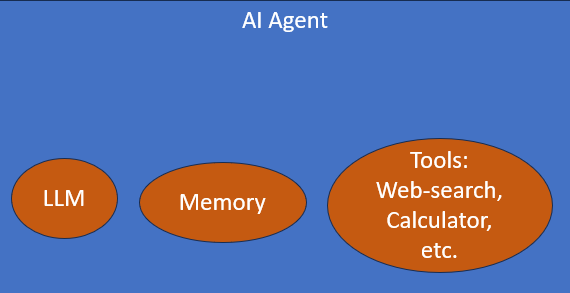
The Core Anatomy of an AI Agent
Every modern AI agent has 3 core components:
- LLM (The Brain): The underlying foundation model (like your gpt-4o-mini). It provides the semantic understanding, logic, and linguistic processing required to parse requests. It also acts as a planner and breaks down complex, multi-step goals into a clear task list. If a step fails, the planner dynamically reframes the strategy.
- The Memory: This allows agent to recall / remember. Short-term memory tracks the active user chat session, while long-term memory saves user profiles and historical interactions across weeks or months.
- Tools (The Hands): External functionalities integrated into the system. An LLM on its own cannot access live internet data or calculate advanced physics equations. Tools—like your get_weather function or web-browsing APIs—give the agent the power to interact with the outside world.
Simple Example: Chatbot vs. AI Agent
To clearly understand the difference, look at how a simple chatbot and an autonomous AI agent handle the exact same prompt:
The User Prompt: “Book a table for two at a highly-rated Italian restaurant nearby tonight at 7 PM and calendar it.”
- A Standard Chatbot: It cannot access real-time data or external applications. It will respond with generic advice: “I can’t browse real-time options, but here are 3 popular Italian dishes you could look for on Yelp!”
- An AI Agent: It initiates a programmatic workflow:
- Perceives: Identifies your location data and current time.
- Plans: Decides it must search restaurant directories, verify 7 PM openings, check reservations, and then ping a calendar API.
- Acts (Uses Tools): Calls a web search tool to find top restaurants, triggers an OpenTable API to see booking slots, executes the reservation, and writes an .ics calendar invitation file.
- Delivers: Responds to you with confirmation: “Table booked successfully at Mario’s Bistro. The invite has been added to your calendar.”
Common Frameworks for Building Agents
If you are writing production-grade code, developers rarely build agents from raw scratch. They rely on specialized agentic orchestration frameworks:
- LangChain / LangGraph: Excellent for building explicit state machines and cyclical graph architectures.
- CrewAI: Designed around role-playing agent dynamics (e.g., setting up a “PM Agent” talking to a “Dev Agent”).
- Microsoft AutoGen: Ideal for event-driven, multi-agent conversation topologies.
- N8N: Helps automate the agentic workflow. It is part of low-code approach.